Monday, 13 January 2020

A blue-blooded soap opera

Right at the outset, let me tell you this. I'm not a Briton. And considering what the country is going through, I'm glad that I'm not. To be clear, these ARE tough times across the world. Close your eyes, pick a random spot on the globe, and chances are there are problems brewing there. Either in the form of a secessionist movement, or dissatisfaction with the incumbent government. But not in GREAT Britain. While knee-deep in the quicksand called Brexit, the country has found something far more important to worry about - Prince Harry and Meghan Markle. 

They've had enough!
Are they interesting to read about? Sure they are! Are they a glamorous couple? Of course and god bless them! But do they affect the lives of common Britishers? Absolutely not! Do they solve the problem of NHS? Nein! So talking about the so-called Megxit issue is an absolute waste of breath, because at the root of the problem is an antediluvian institution that prolongs its existence by making a fool out every man in the UK - the British monarchy. Or as we call them in India, the 'loan that was never repaid'. The entire episode around Harry and Meghan brings out the worst face of the British monarchy. A racist, classist, misogynist, and highly insecure family whose biggest achievement is their 'birth'. For long, people have blamed the institution and never the actual members of the family. But this time, there is no excuse. The Queen, the Prince of Wales and Prince William are equally responsible for what is unfolding now in Britain. 

Should we empathise with Harry and Meghan? This is a complicated question. Without a doubt, the two of them were treated harshly by the British press. While our teenage escapades tend to remain in our own circles, theirs ended up on the front page as headlines. But that's what most celebrities call 'everyday life'. Life in the limelight can be difficult, and sometimes outright cruel. That's hardly a thing to crib about when your entire livelihood is being funded by the taxpayer. Harry and Meghan have every right to leave this life behind. And they have the tools to make it in the real world. Meghan was a very successful actress before she married, and Harry I'm pretty sure is not completely useless. My problem is with the reaction that this decision has garnered. 

A crisis meeting! That's what the Queen convened to discuss the situation. And on the agenda was a very simple topic. How to deal with Megxit? But the answer is very simple - there is no way to deal with it, because there is no problem in the first place. The monarchy is still stuck in its halcyon days, when Prime Ministers were servants and the public were a nuisance. The silliness of what is unfolding in Britain is unbelievable. And the amount of air-time being given to a non-existent problem is really a sad bit of news. Let them discuss this as a family. As a grandmother trying to make her grandson stay...or as a father trying to make his son stay....or as an elder brother trying to make his younger brother stay. But overreacting to this situation is an important step for the royal family. After all, the monarchy's biggest achievement has been convincing the public of its necessity. 

Entitlement is my birthright, and I shall have it
But how did we reach here? Things must have been pretty bad for the two of them to basically walk away from a life of entitlement. Ever since their engagement, the right wing press in Britain have been gnarling at their feet. Harry has never been a rule-abiding well-behaved prince like his brother William. Maybe being further away from the throne gave him the freedom that William never enjoyed. And then Meghan entered the picture. She was an actress, a divorcee and a person of mixed racial heritage. So for the royal family, she was like the anti-Christ. But nevertheless, love pulled through, and the two got married. And even for a republican like me, the wedding was truly magical. But almost immediately after the wedding, things started to go south. The fact is Meghan is too liberal for the family. A woman with a voice and an opinion is a threat to the monarchy, unless she's in-line for the throne. In which case she's decisive and well-informed. The duplicity is pathetic. So if you're waiting for a list of reasons why Megxit is happening, there aren't any. The royal family could not stomach the Sussexes' free-thinking. And they stood by and watched as the press tore them apart for the smallest of things. 

So if anyone is responsible for this crisis, it's the very people who are trying so hard to solve it. And this should ideally get the people of Britain thinking. At least in India, our government tries to destroy our secular fabric when our economy isn't doing well. That's how we hide the real issues in India. But you have an entire institution catering to this. A royal wedding, a royal baby, a coronation, or a royal separation. Nobody's talking about Brexit are they?

Thursday, 9 January 2020

It's remarkable how unremarkable Macron is!

Macron with former president Hollande
Here's the thing about leaders like Modi and Trump. They are controversial, even genocidal some might argue(and rightly so). When you share the stage with those kind of leaders...hogging the limelight can be a very difficult thing to do. You can either be just as bad as them, like Boris Johnson. Or chart a different course at your own expense. Enter French president Emmanuel Macron. A former investment banker, and a self-proclaimed centrist. There's nothing that stands out in Macron's personality. I don't understand a word of French, but I can still make out that he's a bad orator. His demeanour is often tentative and he was quite literally manhandled by Trump on one occasion.

But Macron has his moments. His policies are largely popular(we'll get to the bad part later). And in an era of autocrats, Macron has been willing to spearhead moves aimed at diffusing tensions in theatres of conflict. And he's not afraid to be outspoken. It takes a lot of courage to call the NATO a 'brain-dead organisation'. He's taken on Brazil's Bolsonaro and Turkey's Erdogan, and more importantly come out unscathed from those battles. Truly a remarkable achievement. 

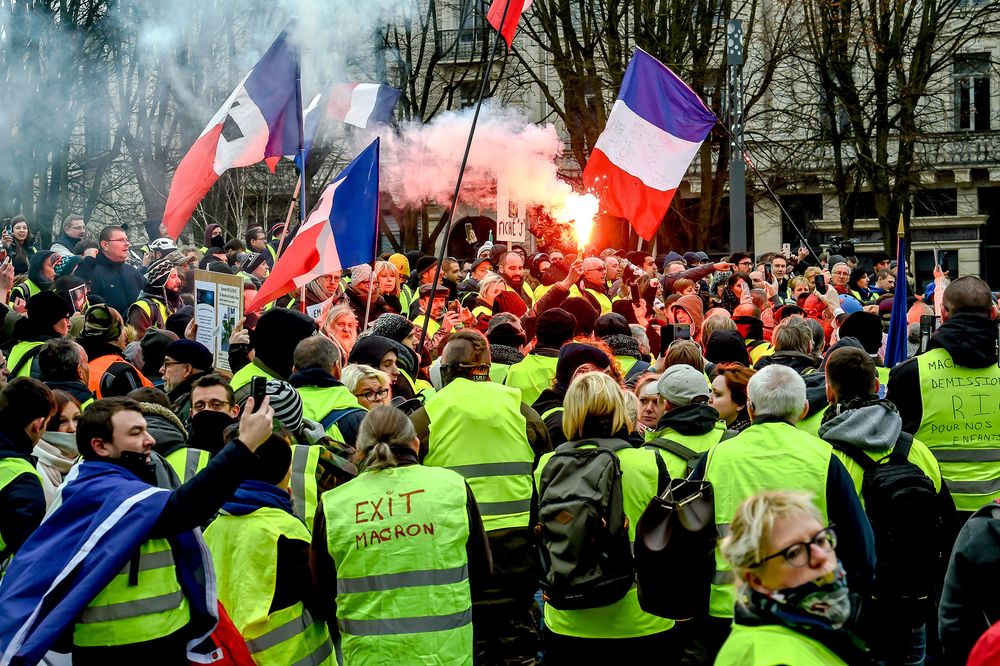
Yellow vest protesters
But all's not well for Macron at the moment. Within France he's facing one of the largest popular movements in 21st century Europe. And his foreign escapades have garnered some attention to. But as our ultra-nationalists keep saying, 'country first'. So let's talk about the domestic problem. Macron came to power with a promise to bring about sweeping economic reforms.

Yellow vest protesters
 As a member of former president Hollande's government, Macron had already started introducing some of these changes. After he took over, Macron has pushed on with it. But not without opposition. Opposition from a grassroots level movement of men and women wearing bright yellow vests, usually donned by construction workers. The yellow vests movement broadly stood against economic injustices. But they had some galvanising issues, like the wealth tax. Once in office, Macron repealed the wealth tax and replaced it with a tax on real estate. Big mistake! The wealth tax was hugely popular among the working class in France. And repealing it gave the impression the government was pro-rich. Fuel prices also rose considerably during this period. Thousands took to the streets, but Macron stuck it out. The protests crippled transport networks in major cities like Paris. But the president was unmoved. Today, the movement has largely fizzled out. But that's when Macron dropped his second major reform.

Protests against pension reforms
It's an unsaid rule in French politics - you don't touch pensions. But Macron decided to, anyway. And he's without a doubt burnt his hands. France has an extremely complicated pension system. But here's the gist of what Macron has done. He has decided to unify 42 pensions schemes into a single system based on points. The current scheme is extremely popular. For one, it accounts for the kind of work you do. A more demanding job like that of a train operator will fetch you the same amount of pension at an early age. 

Macron wants to unify France's 42 pension schemes

But under the new system, it's all about the points you accumulate. And you accumulate more points by working for more years. The age of retirement under the new scheme is 62 years. But you get a bonus for working for two more years. Effectively, a person in France will have to work until 64 years to receive a good pension. For a country like France that prides itself on its welfare system, this was too much to take. Workers' unions took to the streets and major cities including Paris were paralysed. 


There is merit in Macron's new plan. Popularity is not a justification for stupidity. Many experts do agree that France's pension plan needed reforms. This new one will benefit people who change professions mid-way. Women will also receive equal pension under this scheme(can't believe they are still contemplating this in 2020). As the government looks to firefight what is the second mass movement in the last few years, the president has gone missing. 

Macron with his firefighter PM Philippe
He has fronted prime minister Edourd Philippe to shore up his government's decision. For anyone unfamiliar with France's political system, the French PM is nowhere near as powerful as the president. Macron's only reaction was an appeal for calm during the holiday season. And when you think about it, that's the kind of guy Macron is. Looking for mediation, where decisiveness counts. And asking for a ceasefire when peoples' life-savings are in question. Not a wise move. 


On the international stage, Macron has become the negotiator-in-chief. From Ukraine to the Sahel, Macron has revealed his taste for foreign policy. And he has been successful. Along with Germany, Macron managed to bring Ukraine and Russia to the table. The summit ultimately led to a high-profile prisoner swap between the two countries. But there is ambiguity on his stance vis-a-vis Europe. Macron opposed the enlargement of the European Union, and effectively killed talks on the possible inclusion of Albania and North Macedonia(cheap shot). Combine this with his scepticism on NATO, and the question is - does Macron want a more closely knit EU that is devoid of U.S influence? An EU that can challenge the global hegemony of the U.S? 

Macron with Germany's Merkel

Macron's love-hate relation with Trump
Don't let his mumbling persona fool you. As I said in the beginning, this man can make some rather courageous moves. One such move was a digital tax on foreign tech companies operating on French soil. The likes of Twitter and Facebook are likely to be the most affected. Trump was furious. He loves Twitter, but not the man who runs it. The same can be said about Facebook. Trump is allowed to hate American tech companies, but no foreign country can even dream about doing that. U.S has retaliated with tariffs on French wine and cheese. You could argue that this is a needless trade war. Especially considering Trump has no clue how tariffs work. 

If you're wondering when the 'unnecessary foreign intervention' is coming...well, we're there. The Sahel, a stretch of land straddling western and central Africa. The countries in this region include Niger, Mali, Mauritiana, Chad, Burkina Faso, Ivory coast, Senegal and a couple of others. France is leading the U.N-mandated anti-terror operation in this region. Under Operation Barkhane, France has deployed close to 4,500 troops in the Sahel. If you're wondering why that's a big issue, take a look at that list of countries once again. Many of them have been French colonies in the past. And sending your troops to the country that you once ruled over illegally is not really a favourable 
message.
Macron with Sahel G5 leaders
To Macron's credit, he has largely stayed away from the politics of the region, and repeatedly denied charges of imperialism. But the move is distasteful due to the sheer optics of it. To be clear, it wasn't Macron who placed troops in the Sahel. That decision was taken before he came to power, back in 2014. But Macron has doubled down on troop deployment. For a foreign affairs-savvy Macron, the situation in the Sahel is exciting. But the problem is, he's nowhere close to winning the war. Militants have been gaining ground recently. France lost 13 soldiers in a helicopter crash in Mali while fighting militants. And Macron's response was to send more troops and American reaper drones. 
Macron with troops in West Africa


Macron is up for re-election in 2022. And despite the wave of protests and his 'hit or miss' diplomacy, Macron is expected to retain the presidency. This is because Macron represents a voice of reason in a world that's veering to the right. Europe too has been caught in this frenzy. Right wing parties are doing well in Germany. And Boris' Britain.....well, fill in the gaps. Macron defeated a hardliner named Marine Le Pen to claim the presidency. The election was literally a no-contest once Macron placed himself at the ideological centre of a country that has been far-left or far-right most times. Macron's centrism was the perfect choice for many who wanted a cocktail. 

At the end of the day, Macron is likable. He looks like an average Joe who rattles out unemotional speeches. But that's exactly who Macron is. A man who basks in how remarkably unremarkable he is. Nothing justifies this image of Macron than the picture of him at the FIFA World Cup. Cheering like a giddy school boy, as his team scored a goal. But maybe that's the balm an embattled and right-leaning Europe needs right now. 

Macron at football match Vs Croatia


Friday, 3 January 2020

Trump drops a New Year bomb in West Asia


You’re sipping a nice margarita during your vacation in Florida. What’s on your mind? Normal people would think about how nice it is to get away from work. Or about the summer that’s headed your away. But not Donald Trump. He was tweeting out a picture of the American flag after having ordered the killing of Qassem Soleimani – the most powerful general in Iran. Just 2 days into 2020, and Trump has given us his Samuel L Jackson moment already. Taking out the commander of Iran’s Quds force is no mean feat. And hand it to Trump for doing it while on vacation.

Iran's spymaster Qassem Soleimani killed
A little after midnight, a group of Shia militants from Iraq’s PMF were escorting ‘special guests’ from the Baghdad airport in their own SUVs. And that’s when 3 U.S rockets hit them near the cargo terminal. Information was coming in at a snail’s pace. The PMF immediately blamed the attack on the U.S. And there was radio silence from the Americans. But as soon as reports of militant casualties emerged, the picture was clear – this was indeed a cold and calculated U.S operation. But it wasn’t until much later that Qassem Soleimani’s name figured in the list of casualties. Surely the Americans wouldn’t take out one of the most powerful men in Iran! Assassinations are by definition, daring. But there would be no coming back from such an escalation. But that’s Donald Trump for you. There was no last-minute calling-off this time around. Not just Soleimani, the deputy commander of the PMF was also killed in the strike. Two top commanders from Iran and Iraq, killed in a single blow.

The U.S military was probably tracking Soleimani for a long time now. He had been making trips to Baghdad regularly, due to the anti-govt protests over the last few months. And taking out a convoy was never going to be a problem for them. But what next? Can the U.S withstand the fallout from such a high-profile killing?

What was left of Soleimani's convoy

Countries were quick to take sides. Needless to say, Syria sided with Iran. They called the U.S act cowardly. Russia too said the strikes would escalate tensions. China called for calm and restraint, the kind it’s showing in the South China sea and Xinjiang. And there was white noise from Britain, France and most American allies. And when they did react, it was with a message of de-escalation. This is not the early 1990s or the 2000s. The power equation has changed. Trump will find it difficult to create a coalition in west Asia this time around. But more than the silence from its allies, it is the active condemnation from Iraq that is likely to irk Trump. The Iraqi PM called it a gross violation of the security arrangement with the U.S. The U.S got away with incisive strikes on sovereign soil during bin Laden and Baghdadi. But those were known terrorists, hiding in unknown locations. Soleimani was no bin Laden. This was a man who headed a legitimate wing of Iran’s Revolutionary Guard. Political differences led to the Quds being designated as a terror group. And Soleimani’s designation as a target. But don’t for a moment think that the man was a saint.


Soleimani was Iran’s spymaster. He pulled the strings from behind, while his Quds force unleashed havoc against American troops. U.S claims that he was behind the death of 17% of all American personnel between 2003 and 2011 in Iraq. So, America definitely had an ax to grind. You could even say a justifiable one. But this puts the entire region on a knife’s edge. Any government worth its salt would respond to such an act. And Iran’s leadership is working overtime to rally the country together. From the Ayatollah to the common man on the streets of Tehran, the message is clear – revenge. But that’s easier said that done. America has an impulsive, trigger-happy president who is fighting an impeachment trial in an election year. Is that the kind of animal Iran wants to spar with? Moreover, the gulf between the two militaries is too wide. A fighting spirit can win you a war, but only in cinemas. In the real world, you would be forced to retreat with your tail behind your legs. So, Iran is unlikely to respond in equal measure. But they could of course prove me wrong and go on an even more adventurous mission. But let’s hope better sense prevails…for everyone’s good.


But Iran could hit U.S right where it hurts. At its oil-chugging belly. One snap of its fingers, and the Strait of Hormuz shuts shop. Say goodbye to 30% of world’s oil supply. This threat is real. This threat is practical. And this threat is probably on Hassan Rouhani’s to-do list. Just a couple of days back, Iran, Russia and China were conducting war games near the Gulf of Oman. And it doesn’t take a genius to guess that the Strait of Hormuz was indeed part of the plan.

But on to the more important question- what was Trump thinking? An easy answer would be - he wasn’t. But there is some rationale hidden beneath this outrageous strike. The U.S says they were in possession of intel that led them to believe that Soleimani was planning something big. That’s entirely possible. Especially considering the recent U.S strikes against Kataib Hezbollah and the subsequent storming of the U.S embassy by pro-Iran militias. As evident from this strike, even the U.S was planning ‘something big’. Trump’s military advisers would have briefed him about the risk of going after Soleimani. And if he did go ahead with it, maybe he knew something that isn’t in the public domain yet.

While the U.S action was no-holds barred, its reaction after the strike has been measured. No chest-beating like during Baghdadi. This shows that the U.S realises how sensitive things are right now. Too much posturing would push Iran to do something drastic. That would be a rudderless slide, that both sides will be unable to navigate. For now, the New year could not have started on a more dangerous and febrile note. West Asia has been a conflict zone for as long as I can remember. But something about the current situation, just feels a bit more than a newspaper headline.

Wednesday, 4 December 2019

Move over Game of Thrones, NATO is here!

Divided we stand!


This week in London, we all got the answer to the question - what would happen if a bunch of disgruntled family members came together for dinner. It was a recipe for disaster, and we weren't disappointed. Even before NATO's anniversary summit in London, the alliance was on the rocks. Turkey chose to become the rogue son and went ahead with its Syria operation. All the NATO allies could do was stand around and condemn. At the end of the day, NATO was useless. Erdogan got what he wanted, so did Putin - a foothold in West Asia. And then there is the issue of the s-400 missiles that Turkey bought from Russia. A blatant show of contempt to its western allies. But NATO again just stood and watched. A classic example of the family failing to rein in their son, even though they see him hanging out with the bad kids.

Emmanuel Macron, the French president called the alliance 'brain dead' a couple of months back. Macron feels the NATO needs a wake up call, and I couldn't agree more. During the cold war, NATO had a purpose...a mission that everyone agreed on. And the Soviet Union played the best bond villain NATO could have asked for. But who is the common enemy now? Russia? The same Russia from whom Erdogan bought his missiles? Or China? Now China's a complicated subject. The western world realises that China is the future. So they don't really want to poke the dragon too much. But this just makes it one more reason why the NATO is useless. Right now the alliance is going through an identity crisis. In the absence of a common enemy, NATO is struggling to justify its existence. And the current crop of leaders aren't helping either.

Gossiping behind a leader's back. That's what NATO descended to in London. Macron, Trudeau and Johnson were seen indulging in a 'roast trump' session, taking potshots at Trump's impromptu press conferences before departure. Was it fun? Of course it was. Anything that insults Trump is fun to most people. But it reveals a much deeper problem for NATO. The United States is the glue that holds the alliance together. Militarily and financially, the U.S stands way ahead of its fellow allies. And the gossip session shows a complete lack of respect for the current American leadership, and this does not bode well for NATO. And Trump being the guy he is could very well decide to make this a clash of egos. He's already mulling a budget cut, maybe this is the push he needed. Without American money, and American weapons, the NATO is not the powerful alliance it claims to be. And the fallout from the gossip session is already visible.

Trump decided to cut short his trip, and cancel a scheduled press conference. But he's not the kind of guy who leaves without a parting shot. And Trudeau was at the receiving end. Trump called his northern neighbour 'two-faced'. And for anyone who has actually dug deeper into Trudeau's record, that's the perfect description. Under the suave Harvey Dent veneer is a man who is helming a multi-million dollar pipeline project that will harm the environment and the tribal population.

Trump says that he's gotten the non-U.S members to contribute $130 billion more to NATO every year. And that there has been no increase for the U.S, except for respect! Let's ignore the fact that this seems like a line lifted from a gangster movie of the 70s, what does it say? Trump actually seems to be firefighting for the NATO. Clearly the summit was a disaster. Nobody is gonna move past the gossip session, because that's what NATO is about. The alliance is based on friendship, and mutual respect. The moment that goes out the window, NATO becomes a burden for the member nations.

This Christmas, no family is more divided than NATO. Just like a normal family, maybe the NATO too needs a bit of magic. What about an imaginary USSR for a gift?


Friday, 18 October 2019

What's with dictators and horses?

If you're wondering whether 'horse' is a representative word for dictators' weird idiosyncrasies, you are not wrong. But as things stand, the statement holds true even literally. Dictators are complicated people. Despite being the worst face of humanity, they often manage to capture the imagination of an entire country. They make people buy into narratives that they would normally be disgusted by. But research has shown that on a personal level, there are many parallels between dictators. Despite their tough veneer, most dictators are highly insecure about their position. And their thirst for violence is symbolic of their need to assert dominance, the result of a disturbed mind. But analysing the psyche of the most terrible men to walk the earth can be a boring effort. So I will let horses do the talking...

Horses are majestic creatures. They feature in most historic tales and often play an important role. This is because there is symbolism associated with horses. Power, glory, strength, wisdom...just to name a few attributes that horses are believed to embody. And these attributes are something strongmen crave for. Horses also cater to the archaic notion of masculinity in many societies. And it is well established that dictators have always tried to portray themselves as hyper-masculine. This is driven by a belief that the general public would trust the leadership of a man who can pick up a gun and fire a couple of rounds...or indeed ride a horse. This has made the animal a mascot which has been used time and again by autocrats across the world. 

Like any good theorist, it's important to back your hypothesis with arguments and facts. So let's start with the 'tyrant in the north', Vladimir Putin. Despite sporadic protests over the lack of civil liberties, Putin continues to hold an iron grip over his country. In the global stage, Russia is Putin. There is no Russian opinion that holds water in front of Putin's ideas. Putin's horse ride was extensively covered in the media. Indeed the leader took it a step ahead since he was also riding bear-chested..again a show of hyper-masculinity. 

Putin riding a horse in Siberia

There is a little known dictator in Turkmenistan called Gurbanguly Berdimuhamedow. He's been in power since 2007 and exhibits all the eccentricities of an insecure tyrant. I was introduced to Berdimuhamedow and his love for horses by comedian John Oliver. While for other dictator's the relationship with a horse is a propaganda demand, Berdimuhamedow takes it too seriously. He writes poems for horses, and has an large number of horses in his possession. 

Turkmenistan' Berdimuhamedow has a weird interest in horses

Iraq's Saddam Hussein was also an ardent lover of horses. He and his sons used to reportedly visit equestrian clubs and watch horse races. Saddam too had an impressive number of horses which were later freed by the American forces. 

Turkey's Erdogan has a complicated relationship with horses. Back in 2003, a horse recognised Erdogan for the tyrant he is and jerked him off its back before kicking him in his private parts. The video has since then become the punchline to many jokes. For most people, such an incident would be traumatic. Many would prefer to stay away from riding horses, especially if you are a strongman whose public perception is like your oxygen. But Erdogan was at it again in 2017, when he was clicked sitting on a horse.

Erdogan's complicated relationship with horses

Benito Mussolini too had his horse moment. When he decided to award himself the title of Protector of Islam, Mussolini received something called the Sword of Islam. He was later pictured with the sword, straddling a horse. A horse monument was also built to celebrate the title.

Benito Mussolini clicked straddling a horse

No list on dictators is complete without the most hated man in human history...Adolf Hitler. We've never seen Hitler ride a horse as such, probably because of his contempt towards anything that can breathe. But Hitler definitely understood the symbolism of the horse. During the days of his third Reich, there were bronze statues of horses that stood in front of Hitler's chancellery building.

Bronze statue outside Hitler's chancellery

The list is completed by North Korea's mass murdering man-child Kim Jong-Un. North Korean state media released pictures of Kim riding a white horse up a sacred mountain. The symbolism was evident, as one can assume safely that a horse is not Kim's regular mode of transport. The idea was to strengthen Kim's personality cult and showcase his physical prowess on a horse.

Kim Jong Un riding a horse in Mt Paektu

If we dig deeper in history, there are multiple instances of monarchs and despots preferring horses as the major mode of transport. But since horses were technically the predominant form of transport in those times, the context and symbolism may not apply like in the above cases.

Understanding a dictatorship requires a lot of research on the political system of the country, the dictator's own childhood and temperament among other things. But some things are easily extrapolated through historical facts. Like how most dictators are similar to fast bowlers in cricket. They work in pairs. Hitler and Mussolini, Kim Il Sung and Stalin, Putin and Assad, Kim Jong Un and Xi Jinping. These are some examples of the symbiotic relationship that dictators maintain. This of course is because of the realisation that only another tyrant with no human emotion will help them out. Self-preservation is the key. 


Saturday, 12 October 2019

Misogynists-in-chief who rule the world


Society has always been reluctant to elect women into positions of power. Across the world, politics  has remained male-dominated, much like most other spheres. And it's not like leaders have done anything to change this regressive dynamic. On the contrary, they have milked society's narrow-mindedness to their advantage. Toxic masculinity has propelled many politicians onto the top post... just look at the White House. In recent times however, the trend has reached alarming levels with blatant sexism becoming a poll pitch. There are almost 200 countries on the face of the earth, and only around 25 have female heads of state or government. Among the most powerful countries, this list is even more lopsided. The problem is not just lack of representation, it is the attitude of the men who are currently in power.

A case in point is the President of Philippines, Rodriguo Duterte. This man is an embodiment of this article's header. His speeches can be best described as a volley of nonsense and toxicity. For Duterte, the following are just 'jokes'. He once made a lewd comment about his own Vice-President's skirt, and that too at an event which had typhoon survivors in attendance. Duterte once proclaimed that he had asked his military to shoot female guerrilla fighters in their genitals. He also made a rape joke about an Australian missionary who was raped and killed during a prison siege. Safe to say, Duterte is an enemy of mankind with not even an ounce of civilisation in him. But what's worse is how the public often react to his statements. His inappropriate jokes are greeted by raucous applause from his supporters. 

British Prime Minister Boris Johnson thinks he is the Incredible Hulk, but a close look at his past comments suggest he is an incredible creep. Johnson, during his days as a journalist was a serial offender. He was once at a Labour conference, after which he wrote a piece dishing out some poison about 'the hot totty' present at the event. Fast forward a few year, and this was Johnson's advice to his successor about how to treat a female co-worker. "Just pat her on the bottom, and send her on her way." He recently called his political rival Jeremy Corbyn a 'great big girl's blouse'. 

Across the Atlantic is Boris' mirror image Donald Trump. Trump wears his misogyny on his sleeves, and does not even bother to deflect attention. Trump does not flinch when he objectifies women, in fact he thrives in the middle of such controversies. His so-called 'locker room' talk did virtually no damage to his poll numbers. In one of his books, Trump calls women inherently manipulative. There is simply no point trying to build a case against Trump, since he does most of the work himself. 

Closer home, Narendra Modi is no stranger to sexist comments. He was once kind enough to praise Bangladesh's leader Sheikh Hasina for tackling terrorism 'despite being a woman'. Sexism is the norm in Indian politics. From Mulayam Singh to Rahul Gandhi, the rot is widespread. 

Brazil's Jair Bolsonaro who basically despises anything that can breathe and think freely is another example. He recently retweeted an extremely lewd social media post about French President Emmanuel Macron's wife Brigitte Macron.

Were world leaders always like this, or is the growing public attention bringing more instances to light? Needless to say, people are more aware of the line that should not be crossed. A couple of years back, dog whistles were very common in political speeches. Not to say they are not anymore, but people identify them more easily nowadays. For background research on this piece, I went online to find instances were former President Obama was misogynistic. Unfortunately, I couldn't find any. Or maybe it's because they are not well documented. But the theme is recent. This decade has thrown up some pretty eccentric leaders. They keep us entertained, and make headlines that read like punchlines for a joke. But they are also extremely dangerous. Behind their benign facade of being beautifully dumb is a toxic mindset that can corrupt an entire nation.

But trailblazers are getting more attention nowadays because of the growing public attention that was just mentioned. New Zealand's Prime Minister Jacinda Ardern is a shining example. Her reaction to the Christchurch shooting probably deserves to be canonised as a guidebook. She led her country out of a traumatic incident in the best manner possible. And she cracked down on gun laws immediately.

So what's the solution? Well when it comes to toxic leaders, there is just one option, universal vigilance. Misogyny cannot be a popular opinion, and it is incumbent on civilians to make sure it does not happen. Politics has been around for centuries, and we must realise by now that politicians don't reform themselves. It takes constant rebellion and ultimately voting them out of power to be rid of their policies. 


Saturday, 21 September 2019

Kashmir, Hong Kong and West Papua: A tale of 3 protests!


Convergence is a rare concept. The world is built on diversity, and anything that is too similar immediately becomes the centre of attraction; an anomaly so to say. So, what are the chances that 3 regions in the same continent would face problems of uncanny similarity? Protests have become the norm in West Papua, Hong Kong and Kashmir over the last few months. There is a common template to the demands being made by the people living there. There is a stench of betrayal that fills the room when their far more powerful mainland tries to negotiate a truce. There is a case of divided loyalty and identity that haunts the residents of these 3 places. And there is a colonial hand in the mess that they find themselves in.

KASHMIR


The perennial bone of contention between India and Pakistan, Kashmir has long been the unscalable mountain for leaders on both sides. The present government has brought with it a new approach to the issue. Forceful integration. ‘Kashmir is an internal matter of India’. This has been New Delhi’s stand at all international summits since it decided to suspend Jammu and Kashmir’s special status. J&K is now like any other ordinary state in India. But is it? Which other state in India does not have Internet connectivity? Which other state in India has this kind of heavy military presence? Kashmir never was like any normal Indian state, and is unlikely to become one in the near future.
Kashmir’s monarch ceded with India after coming under attack from Pakistan. By the time fighting stopped, Pakistan had under its control what is today know as PoK. India’s J&K and Pakistan’s Azad Kashmir is separated by the Line of Control, one of the most militarily active borders in the world. Since then, it’s been a game of claims and counter-claims. India claims Kashmir to be rightfully its. Pakistan has a similar claim.
The current lockdown was triggered by the current government in India. On August 5th, India’s Home minister announced that Kashmir would be stripped of its special status. And how many Kashmiris were consulted before this move? None. Since then, Kashmir has been under lock and key. While the government maintains that peace is returning to the valley, the situation on the ground is far from ideal. Protests are being suppressed without mercy, and information flow is being contained. Kashmiris are reeling under the apathy of the Indian state. The world community is feigning ignorance. It wants India and Pakistan to solve the dispute bilaterally. India’s stand on Kashmir largely reflects the mindset of a large majority of Indians. They want Kashmir to remain an integral part of India. And New Delhi will not give up an inch of space while dealing with Pakistan. Banking on Islamabad to have a reasonable conversation is ‘unreasonable’. Imran Khan has terror groups, rogue military elements and unhappy citizens to satisfy -- a seemingly impossible task. One, that gives Khan little leverage on Kashmir. He wants to tell the world about Kashmir, but the world is least interested in listening to him.
Kashmir is not returning to normalcy. It is limping towards a forced stalemate. Their political leaders are under house arrest, mainstream opposition leaders are turned back from the airport, and communication is down. This is why you don’t see stunning visuals of protest like in Hong Kong. The resentment is there, so is the will. But the will to live is much stronger.

HONG KONG


Protesting against China is an extremely suicidal thing to do. Beijing does not care about human rights, let alone liberty. For them, Hong Kong is a cash bag…their personal cash bag. But the cash bag has now started to think for itself. The cash bag now wants freedom to express its own identity. And the cash bag has nearly brought the mighty China onto its knees.

One country, two systems. That is the template in Hong Kong. It has its own governing and economic system, but the Chinese shadow has always been present. As Hong Kong grew into a financial hotspot, China’s interests became even more blatant. the extent of Chinese influence is quite evident. Look at the city’s chief executive Carrie Lam. Lam herself is a Beijing sympathiser. The controversy in Hong Kong started with the introduction of an extradition bill. The bill would have enabled China to extradite criminals from Hong Kong and try them in the mainland. A seemingly benign bill. But in the hands of China, the bill would have been nothing short of a purge on human rights. Hong Kong was not going to be silent. Thousands took to the streets in a largely leader-less movement. Symbols of Chinese authority were attacked, and transportation was choked. Asia’s financial hub was grinding to a halt.
China started to flex its muscles. Military build-up was Beijing’s answer to the problem, as it is in most cases. But the protesters were having none of it. After weeks of violent clashes and disruptions, Carrie Lam suspended the bill indefinitely. But suspension keeps the possibility of reinstatement open. So, the protests continued with renewed vigour. Leaders emerged from among the masses. Young crusaders like Joshua Wong and Denise Ho became internationally recognised faces. Things were going out of hand. So Lam decided to get rid of the bill completely. She also launched a slew of programs to foster understanding between the rulers and the subjects. Protesters were not satisfied. Here’s the thing about victory, and freedom. It has to be absolute, or nothing.
Hong Kongers now have 5 major demands. Demands that are unlikely to be met by their government. But the protests in Hong Kong are a success story. Not only did it galvanise more than 7 million citizens, it also punctured China’s supposed invincibility. For the first time in its history, Beijing had to concede space. Knowing Xi and his henchmen, they will be planning for retribution.

WEST PAPUA


West Papua enjoys autonomous status in Indonesia. And with good reason. Indonesia has long been treating West Papua like an unwanted child. It is one of the least developed provinces in the country, and has been subjected to racial discrimination. Armed struggle by West Papuans is not a new thing. Every time, Indonesia has responded with an iron fist.
The date is August 17th, Indonesia’s day of independence from the Dutch. An unruly mob of Indonesian nationalists surrounds a hostel in West Papua and hurls racial slurs at the students. The reason? The students allegedly mishandled the national flag. Even the police got involved. They hurled tear gas inside the building and arrested the students. This once again sparked the long dormant dream of freedom in the minds of West Papuans.
Unlike the previous occasions, West Papuans are not alone. They have found supporters from within other provinces in Indonesia. Something that is likely to work in their advantage. Protesters want an end to the racial discrimination that they are facing every day. They want to express their own identity which is distinct from the Indonesian one. And for this, they want a referendum on freedom, something Indonesia will be sceptical about. Indonesia have tried the violent route this time too. They beefed up security across the peninsula, and called for an Internet blackout.

Unlike Hong Kong and Kashmir, West Papua has skipped under the radar of mainstream media. Hong Kong is wealthy, and Kashmir brings with it, India and Pakistan. The rationale of the media is quite evident. What do the West Papuans bring to the table? Aspirations and tales of systemic discrimination? The media still hasn’t learnt to monetise those.


There are lessons to be learnt from these protests. Lessons for the media, lessons for the world community, and lessons for concerned citizens. Take Australia for example. Its Prime Minister slammed China when they likened Hong Kong protesters to terrorists, but its stance changes when it comes to West Papua. Australia is considering handing over West Papuan activist and lawyer Veronica Koman to Indonesia. Similarly, what do you think would be India’s stance on the stand-off in Hong Kong? If Kashmir is India’s internal matter, shouldn’t Hong Kong be China’s and West Papua be Indonesia’s? China has expressed displeasure over India’s move to suspend Kashmir’s special status. At the same time, it has been discrediting the protesters in Hong Kong.
There are more parallels to what’s happening in these three places. All three countries are being governed by strong leaders. Widodo and Modi are of course democratically elected, while Xi has virtually appointed himself president for life. The convergence of these three protests is a great opportunity for the world to take a look at itself. To understand the hypocrisy of many states, and even their own double-speak, unlikely as it may seem. And to the people of Kashmir, West Papua and Hong Kong – you are not alone!